
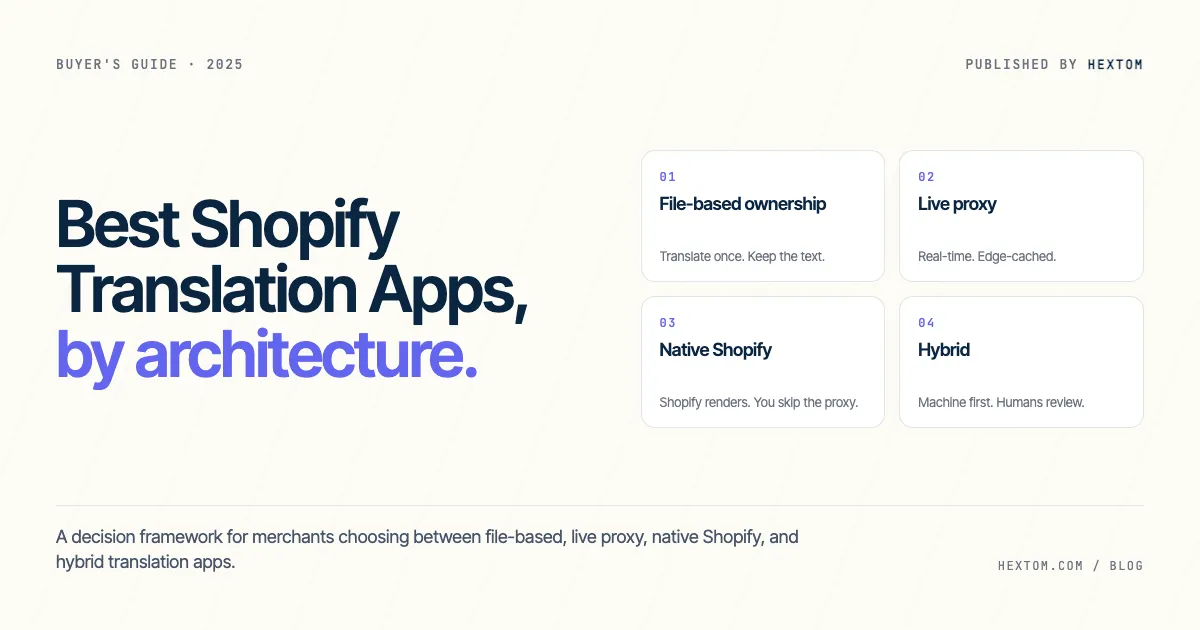
The right Shopify translation app depends less on feature checklists and more on architecture — the way the app stores, serves, and updates the translated copy. Get the architecture wrong and you’ll either pay forever for translations you can’t take with you, or rebuild your localization stack the first time you change vendors. This guide segments the eight Shopify translation tools merchants ask about most often by architecture, recommends a primary pick and an alternative for each segment, and includes a comparison table and FAQ aimed at the questions merchants actually ask.
How to choose: a four-question decision flowchart
Answer these in order. The first “yes” is your architecture.
- Do you need to keep the translated copy if you cancel the app? → File-based ownership (segment 1).
- Does your catalog change weekly, with new products you'd otherwise have to re-translate manually? → Live proxy (segment 2).
- Do you want translation and multi-currency in one app, with translations stored natively in Shopify? → Native Shopify integration (segment 3).
- Is human review on top of machine translation a non-negotiable for your brand or industry? → Hybrid (segment 4).
If you answered yes at step 1 you keep the translations as a static asset; pricing scales with content volume, not with traffic. If you answered yes at step 2 you trade ownership for zero-overhead automation; pricing scales with traffic. If you answered yes at step 3 you trade the broadest feature set for the cleanest Shopify-native install and a bundled currency experience. If you answered yes at step 4 you trade speed-to-launch for reviewed quality.
The four architectures
1. File-based ownership
What it is. You run translations once (often AI-assisted), the app writes the result into Shopify’s native translation API, and you keep the translated text whether or not you keep paying.
Who it suits. Stable catalogs. Merchants who don’t want recurring fees scaling with traffic. Brands that value SEO indexability of static URLs and the option to switch vendors without losing their work.
Tradeoff. New or updated content needs re-translation. Less suited to fast-moving catalogs.
Examples. Taia, Translation Lab.
2. Live proxy
What it is. A reverse-proxy serves translated pages on subdomains (e.g. fr.example.com) or subpaths in real time, intercepting requests and translating on the fly with edge caching.
Who it suits. Large or fast-moving catalogs where auto-translation of new content matters more than ownership. Merchants who want zero manual overhead.
Tradeoff. Ongoing fees scale with traffic. Vendor outage means no translated site. SEO control depends on the vendor implementing server-side rendering — without it, search engines may see only the source language.
Examples. Weglot, GTranslate.
3. Native Shopify integration
What it is. The app writes translations directly into Shopify’s translation system using the official Translate & Adapt API. Shopify renders everything natively — translations live in Shopify’s database, not the vendor’s.
Who it suits. Merchants prioritizing setup simplicity, low overhead, and clean SEO. Stores that want translation bundled with adjacent localization features (currency conversion, market routing) instead of paying for two apps.
Tradeoff. The feature set is bounded by what Shopify’s API exposes. Advanced UX (e.g. visual editor for the language switcher) is usually paid.
Examples. Hextom Translate My Store, Shopify Translate & Adapt.
4. Hybrid (machine + human review)
What it is. A combination — typically machine translation as the first pass, human reviewers refining, finals written either to native Shopify storage or served via a proxy.
Who it suits. Regulated industries, high-AOV brands, merchants where translation quality is a brand-defining concern.
Tradeoff. More expensive. Longer time-to-launch.
Examples. Transcy, ConveyThis.
Recommended app per architecture
For each segment: a primary pick + one alternative, each with a one-sentence rationale.
File-based ownership
- Primary: Taia. Best when you want adaptive AI translation plus permanent ownership of the translated text. Ships translations into Shopify’s native storage, so you keep them if you cancel. (Note: Taia is a translation platform that integrates with Shopify via API — it doesn’t have a Shopify App Store listing. You install it through taia.io and connect to your store, not from the App Store.)
- Alternative: Translation Lab. Best when human-quality matters more than speed. A translator-managed workflow on top of the file-based model.
Live proxy
- Primary: Weglot. Best when your catalog changes weekly and zero manual overhead is the priority. The largest install base among proxy-based Shopify translation apps and one of the few proxies with full server-side rendering on lower paid tiers.
- Alternative: GTranslate. Best when budget is the constraint. Cheaper than Weglot, similar proxy mechanics, less polished SEO control.
Native Shopify integration
- Primary: Hextom Translate My Store. Best when you want translation and multi-currency in one app, native Shopify storage, and a free tier that covers a real first-language launch. Bundles a feature most translation apps charge separately for. (Disclosed: this is our app. We put it here because the translation-plus-currency combo is the real differentiator in segment 3, not because we wrote the article.)
- Alternative: Shopify Translate & Adapt. Best when you want the simplest, free, first-party option and don’t need currency conversion bundled. Shopify’s own app; basic but adequate for a small store entering one new market. (Langify is also worth a look in this segment if you’ve used it before — it predates Translate & Adapt and is still maintained.)
Hybrid (machine + human review)
- Primary: Transcy. Best when you want flexibility to swap between DeepL, OpenAI, and Gemini engines per language. Strong engine-flexibility story; AI-first with light human review.
- Alternative: ConveyThis. Best when post-edit human review on top of a proxy is what your brand requires. Heavier workflow; suits regulated and high-AOV merchants. (Note: ConveyThis re-listed on the Shopify App Store in early 2026; the new listing has fewer reviews than the historical install base — check the live page for current rating.)
Snapshot of the 8 apps reviewed, against the axes that matter when choosing one. Values verified April 2026 against each app's Shopify App Store listing or, where the tool integrates externally rather than via the App Store, the vendor's public pricing page.
| App | Architecture | Languages | Pricing entry | Free tier | Server-side SEO | Currency bundled | App Store rating |
|---|---|---|---|---|---|---|---|
| Taia | File-based | 189+ | Free up to 5,000 words/month · paid platform pricing | Yes (5,000 words/mo) | Not published | No | N/A · external integration |
| Translation Lab | File-based | 10+ (via DeepL/Google/ChatGPT) | Free · $11.99/mo | Yes | Not published | No | 4.9 · 928 reviews |
| Weglot | Live proxy | 110+ | Free · $17/mo | Yes (1 lang, 2k words) | Yes | No | 4.5 · 816 reviews |
| GTranslate | Live proxy | 100+ (Google Translate languages) | Free plan · $9.99/mo | Yes (machine translation, unlimited words) | Yes | No | 4.7 · 660 reviews |
| Hextom Translate My Store | Native Shopify | 130+ | Free plan available · $9.99/month | Yes | Yes | Yes | 4.7 · 1,194 reviews |
| Shopify Translate & Adapt | Native Shopify | 20 | Free | Yes (basic, machine) | Yes | No | 4.6 · 1,412 reviews |
| Transcy | Hybrid | 147+ | Free · $14.90/mo | Yes (1 lang, 1 currency) | Yes | Yes | 4.4 · 2,509 reviews |
| ConveyThis | Hybrid | Not published | Free plan · $11.99/month | Yes (1 language, 5,000 words) | Yes | No | 4.4 · 6 reviews (new listing) |
Sources verified April 2026:
- Taia — taia.io (no Shopify App Store listing — integrates via API)
- Translation Lab — apps.shopify.com/content-translation
- Weglot — apps.shopify.com/weglot
- GTranslate — apps.shopify.com/multilingual-shop-by-gtranslate
- Hextom Translate My Store — apps.shopify.com/translate-my-store
- Shopify Translate & Adapt — apps.shopify.com/translate-and-adapt
- Transcy — apps.shopify.com/transcy-multiple-languages
- ConveyThis — apps.shopify.com/conveythis-ai-store-translator
Cells reading Not published mean the app's App Store listing didn't surface a clear value at the verification date. Cells reading N/A · external integration mean the tool integrates with Shopify via API rather than through an App Store listing, so App Store metrics don't apply.
Frequently asked questions
What's the cheapest Shopify translation app?
Shopify Translate & Adapt is free and Shopify-native; it covers basic single-language expansion with machine translation. Among third-party apps, GTranslate's lowest paid tier and Hextom Translate My Store's free plan are the two most common entry points for merchants who outgrow Translate & Adapt's feature set.
Do I need a paid app for Shopify Markets translation?
No, if your needs are modest. Shopify Translate & Adapt is free and ships translations to Shopify's native system, which is what Markets uses to render localized stores. You'll want a paid third-party app when you need automatic translation of new content, server-side rendering for SEO across many languages, or a bundled multi-currency experience.
Can I switch translation apps without losing my translations?
It depends on the architecture. File-based ownership (Taia, Translation Lab) and native Shopify integration (Hextom Translate My Store, Translate & Adapt) write into Shopify's translation system, so the translated text persists if you uninstall. Live-proxy apps (Weglot, GTranslate) serve translations from their own infrastructure — uninstalling typically means the translated site goes away unless you've explicitly exported.
What's the best free Shopify translation app?
For native single-language expansion: Shopify Translate & Adapt. For free with broader features and a multi-currency bundle: Hextom Translate My Store's free plan. Live-proxy free tiers (Weglot, GTranslate) come with strict word-count limits that most stores hit quickly.
Which Shopify translation app handles SEO best?
Server-side rendering matters more than any other SEO axis. Apps that write translations into Shopify's native storage (Translate & Adapt, Hextom Translate My Store, Taia, Translation Lab) inherit Shopify's SSR for free. Live-proxy apps need to implement SSR themselves; Weglot does, GTranslate's lower tiers may not — check before committing.
How do live-proxy translation apps affect site speed?
Proxy apps add a network hop and a translation step. Most ship aggressive edge caching, so first-byte latency on cached pages is usually within 50-100ms of the source store. Uncached pages and dynamic content (cart, checkout) are where you'll see meaningful delta. If site speed is on your scorecard, ask the vendor for their cache hit ratio and Time-to-First-Byte numbers and test against your own catalog before launching.
Last updated
This guide is reviewed quarterly. Pricing and ratings are snapshot at the verification date noted on the comparison table; vendor architecture decisions change less often.
The Hextom engineering team — we ship 13 apps used by 270,000+ Shopify merchants since 2015. Reach us at hello@hextom.com if a fact in this guide is out of date.